
How to Improve Sprint Speed for Rugby
A practical sprint speed guide for rugby athletes: acceleration, mechanics, testing, and programming that transfers to game day.
Rugby speed is not just a faster 40 metre time. It is the ability to separate in the first three steps, hold posture under fatigue, and repeat high-quality accelerations across a session or match.
Most athletes try to solve that with more running. The better approach is to build the sprint like a skill, measure it, then dose the training so the work stays fast.
Start With The Demands Of The Game
A winger and a loose forward both need speed, but they do not need the same speed profile.
For rugby, the useful questions are:
- Can you win the first 5 to 10 metres?
- Can you stay tall and relaxed once you hit open space?
- Can you brake and re-accelerate without losing position?
- Can you repeat sprint efforts without your mechanics falling apart?
That is why testing should capture more than one number. A 10 metre split tells us about projection and early acceleration. A 20 metre split shows whether the athlete keeps building speed. A 40 metre split gives a clearer read on top-end exposure.
Fix Acceleration Before Chasing Top Speed
Most rugby athletes spend more time accelerating than sprinting at full speed. The first target is usually cleaner projection.
Useful cues are simple:
- Push the ground back, not down.
- Keep the shin angle matched to the body angle.
- Let the torso rise gradually.
- Strike underneath the hip as speed builds.
If the athlete pops upright early, they usually lose horizontal force. If they overstride, they create braking. Video makes this obvious, especially when paired with split times.
Train Max Velocity Anyway
Even if rugby is acceleration-heavy, max velocity work still matters. Higher top speed gives the athlete more speed reserve, so submaximal match efforts cost less.
The mistake is turning max velocity work into conditioning. Keep the reps short, fast, and fully recovered.
A useful starting point:
- 2 to 4 flying sprint reps.
- 10 to 20 metres of build-in.
- 10 to 20 metres of fast exposure.
- 2 to 4 minutes rest between quality reps.
If the rep slows down, the speed stimulus is gone. Stop there or move to lower-intensity work.
Use Strength Work To Support The Sprint
The gym should support the sprint pattern, not replace it. Rugby athletes need enough force to project, enough stiffness to transfer that force, and enough tissue capacity to tolerate repeated high-speed exposure.
Prioritise:
- Heavy lower-body strength for force production.
- Hip extension strength for projection.
- Hamstring strength across lengthened positions.
- Calf and foot stiffness for ground contact.
- Trunk control so posture survives contact and fatigue.
The key is timing. Heavy work too close to speed sessions can flatten output. Put the fastest sprint work when the athlete is fresh.
Measure Progress Every Block
Sprint training gets vague when there is no timing. A stopwatch is usually too noisy for small improvements, especially over short distances.
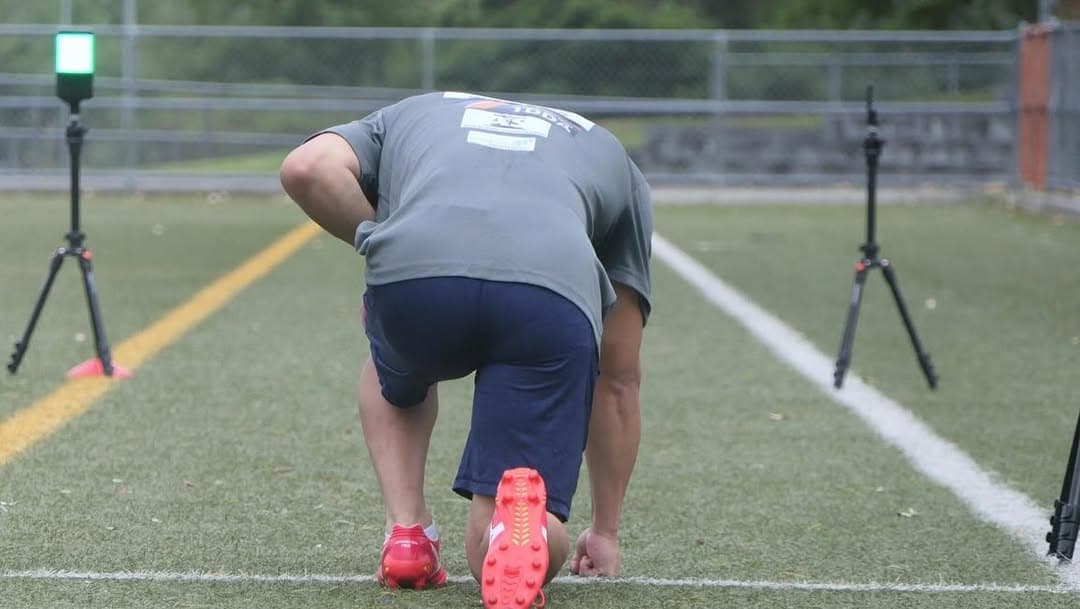
Use timing gates when possible (this is what a one-off sprint test in Auckland measures). Track:
- 10 metre acceleration.
- 20 metre continuation.
- 40 metre open speed.
- Left-right change of direction where relevant.
If the 10 metre split improves but the 40 metre time does not, the athlete may be projecting better but lacking top-end mechanics or exposure. If the 40 improves but the 10 does not, acceleration might need more focused work.
A Simple Weekly Speed Structure
For an in-season athlete, start conservative:
| Day | Focus | Example |
|---|---|---|
| Day 1 | Acceleration | 6 x 10m, 4 x 20m, full rest |
| Day 2 | Strength | Lower-body strength, hamstrings, trunk |
| Day 3 | Max velocity | Flying 10s or 20s, low total volume |
| Day 4 | Rugby training | Skills and tactical work |
The exact week depends on match day, training age, injury history, and coach load. The principle stays the same: speed work is high quality, low fatigue, and measured often enough to guide decisions.
The Main Rule
Do not bury speed work inside conditioning. Sprinting fast is a nervous-system skill. If the athlete is tired, they are rehearsing slower mechanics.
Train speed when fresh, measure the outcome, then build the rest of the week around keeping that output available on game day.
If you want this coached rather than self-managed, our speed training in Auckland runs twice a week on the North Shore, with a dedicated youth speed training programme for athletes aged 12 to 18.